
Posts by Rachel
Hidden holiday gems – Discover the fascinating Euro coins from around Europe
I’m off to Spain soon, and I bet a lot of you are also looking forward to your summer holidays! For me, one of the best things about going abroad is the discovery and experience of new cultures, and that includes foreign currency.
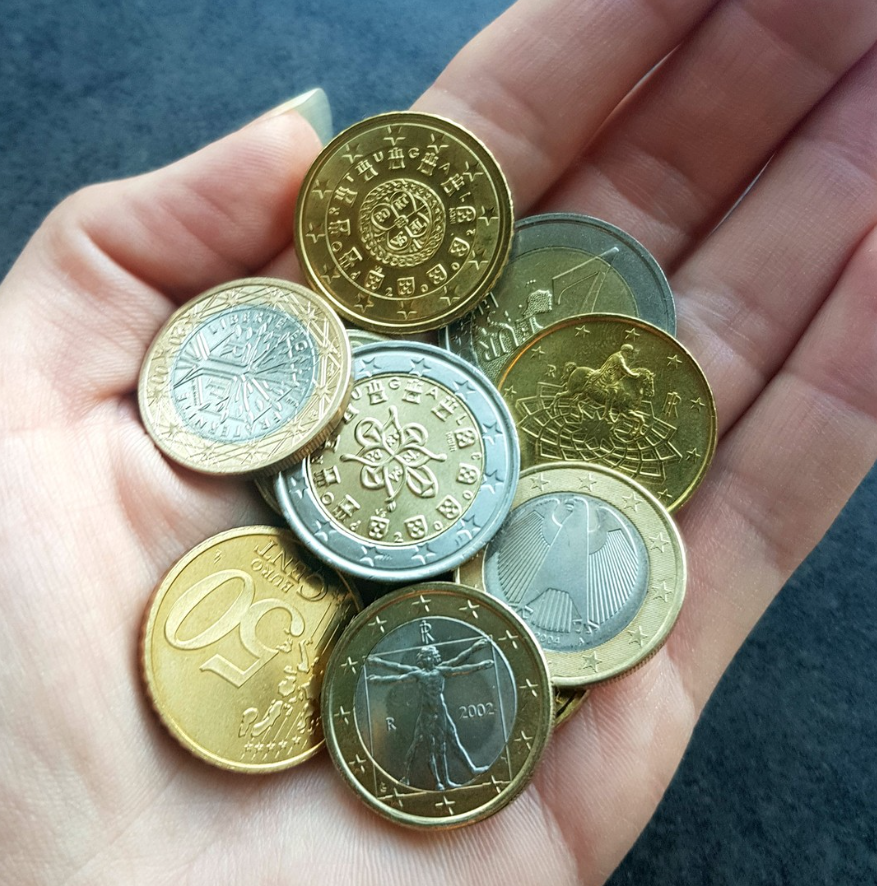
As a Change Checker, I’m sure you also love looking at the different designs as much as I do, and since each currency is unique to its country, you’ll find there is always a story to tell from the change you find abroad.
So whether you’ve planned your next getaway, or perhaps you’ve already returned with a pocket full of foreign currency, here’s some fascinating finds from around Europe to keep an eye out for.
Spain
An ever popular tourist destination for us Brits is Spain, and I’m sure that the Spanish euro is one that many Change Checkers would recognise.
All euros issued before 2015 feature the portrait of King Juan Carlos I who reigned as the King of Spain from 1975 until his abdication in 2014 when his son Felipe VI took over the royal duties. King Juan Carlos I was an interesting Head of State, because he wasn’t born in the country he eventually came to rule, his family having been exiled to Italy due to the abolition of the Spanish Monarchy in 1931.
However, following a coup d’état in 1936, the dictator Generalísimo Francisco Franco took control of the Spanish government, and 11 years later reaffirmed Spain’s status as a Monarchy.

This 2009 2 euro coin designed by Luiz José Diaz depicts King Juan Carlos I encircled by the lettering “ESPAÑA” and the twelve stars of Europe.
Portugal
Portuguese euros are in a league of their own as, unusually, they follow a theme (with the exception of commemorative euros) and the designs do not vary from year to year.
Throughout Portuguese coinage, you’ll find various royal seals of the past: the cross of Knight Templar from 1134, the Rota with cross from 1142 and the Compass rose from 1144, each featuring at the centre of the copper covered steel coins (1, 2 and 5 cents), Nordic gold coins (10, 20, 50 cents) and bi-metallic coins (1 and 2 euros) respectively.

What’s also distinct about Portuguese euros is that they feature a second circle of emblems below the 12-star requirement. This second ring is made up of 7 castle towers and 5 shields, to symbolise dialogue, the exchanging of values and the dynamics of building Europe. This additional design feature was deliberately added as a point of difference in comparison with other Eurozone coinage.
France
With 20 out of the 27 EU member countries using the euro, and each country minting its own unique designs, you’re bound to come across some weird and wonderful looking coins, many of which have been chosen or designed by the public. The French 1 and 2 euro coins are stunning examples of this.
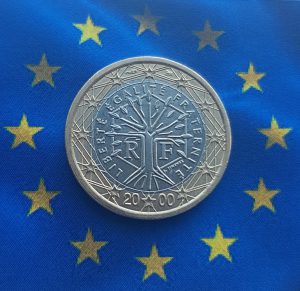
1,200 applicants submitted their designs for the obverse of the French Euro and the successful entry was chosen by a jury. The winning entry by Joaquim Jimenez features a stylised tree in a hexagon, framed by the motto of the French revolution: ‘liberté, égalité, fraternité’.
Italy
Similar to their French neighbours, the public had a hand in choosing the designs for the Italian euros, with each denomination featuring a different image. Creations featuring works by famous Italian artists were scrutinised by a technical and artistic committee before being presented to the public to vote.
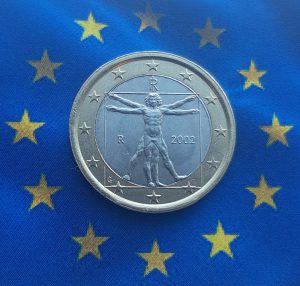
However, in a twist of events during the selection process, the 1 euro coin designs were withdrawn and the former economy minister Carlo Azeglia Ciampi took it upon himself to make an executive decision. He decided Leonardo da Vinci’s Vitruvian Man was the best option, reasoning that the design represents the ‘coin to service of Man’ as opposed to ‘Man to the service of money’.
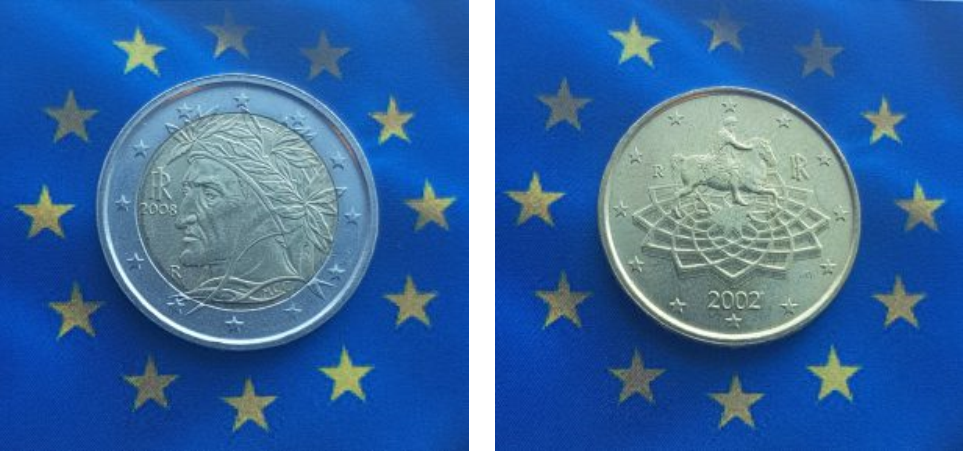
Some of the most iconic pieces of art featured in winning designs include Botticelli’s Birth of Venus on the 10 cent coin, the Equestrian Statue of Emperor Marcus Aurelius on the 50 cent coin and the 2 euro coin features a portrait of Dante Alighieri from Raphaël’s La disputa del sacramento (Disputation of the Sacrament) which you can find in the Pope Julius II Wing of the Vatican City Palace.
A pit stop at the Vatican
If you’re considering popping to the Vatican Palace to see the Raphaël masterpiece, you might want to try and track down some of the most coveted euros – Vatican euros. Euros issued by the Philatelic and Numismatic Office of the Vatican City State are easily some of the rarest euros you may come across, especially the 1 and 2 euro coins issued in 2011, as only 6,000 coins were minted!
Vatican euros are minted with collectors in mind rather than for commercial use, and with the number of coins minted being so small, the collector value is incredibly high. You’re very lucky if you find one of these in your pocket!
Netherlands
Dutch euros are unique in the sense that they only bear one motif, that of the reigning monarch. The first generation euros, issued until 2013, feature the effigy of Queen Beatrix. It is customary in the Netherlands to change the direction the portrait of the monarch is facing whenever a new monarch ascends the throne, so Queen Beatrix can be seen looking to the left whilst the image of King Willem-Alexander featured on second generation euros from 2014 onwards faces right.
A special ‘first’ to feature in this list is the 2003 1 euro coin from the Netherlands, which although currently in circulation is considered to be part of the first generation euro introduced in 1999. What’s interesting about this coin’s design is that at the time they were struck the design satisfied the basic euro coin requirements of having 12 stars arranged anywhere on the obverse, but this changed shortly after the coins entered circulation when new, more definitive design requirements were enforced. All second generation designs required the 12 stars to be spaced evenly apart and in a circular shape in the outer ring, mimicking the shape of the European flag. On the Dutch 2003 1 Euro you’ll notice the stars are compressed onto the left-side of the coin in a semicircle, curving around the profile of Queen Beatrix, rather than forming a full circle to meet the new design specifications.
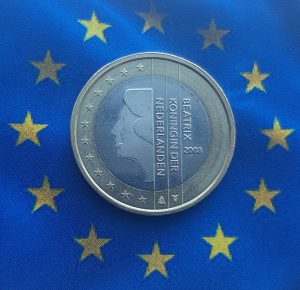
Likewise, all other Dutch coins issued at the same time are considered to be first generation due to their designs which clearly flout the requirements. Most notably, on the 50 cent coin you can see 12 small stars circling the effigy of Queen Beatrix at the centre of the coin, and an inscription reading ‘Koning der Nederlanden’ (Kingdom of the Netherlands) with the name of the Queen and the year of issue engraved where the 12 stars should be (according to the standard guidelines).

Germany
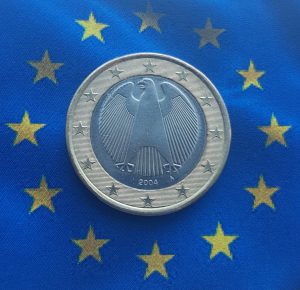
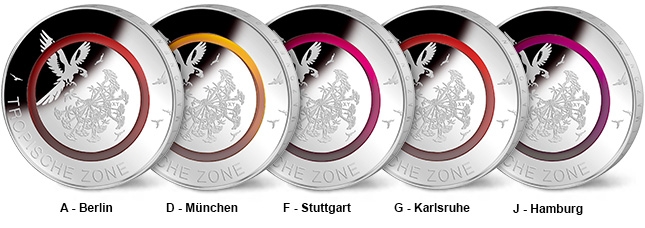
We’ll finish our trip through the pockets of the Eurozone in Germany, where there are several coins of note, including the 1 and 2 euro. These euros feature The Federal Eagle, which holds high symbolic value in Germany. The Federal Eagle is the oldest existing state symbol in Europe and one of the oldest insignia in the world, dating back to Germanic tribes and the Romans who saw the eagle as an incarnation of the god Odin, the supreme deity of vitality and the sun. The symbol was adopted by many states and noble houses in their coat of arms, resulting in a long tradition in Germany. Unlike euros issued in other countries, German euros carry the mintmark of the region where they are minted: ‘A’ for Berlin, ‘D’ for Munich, ‘F’ for Stuttgart, ‘G’ for Karlsruhe and ‘J’ for Hamburg.
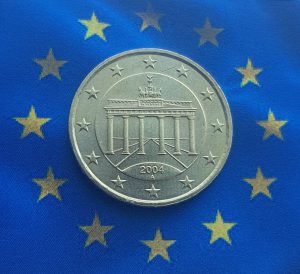
Another main symbol of Germany is The Brandenburg Gate. Located to the west in Berlin it symbolises both the division and subsequent unification of the country, because when built the Berlin Wall cut off access to the gate for both West and East Germany. This image can be found on the German Nordic gold coins – the 10, 20 and 50 cents. The perspective of the design emphasises the opening of the gate, truly highlighting the unity and peace between Germany and Europe.
Our final destination holds by far some of the most unusual euros to be circulated, including the 2016 German 5 euro. This euro made numismatic history when it was issued, as it is not only the first commemorative 5 euro to be issued by Germany, but it is also the first coin in history to feature a brand new material in the minting process – a translucent polymer.
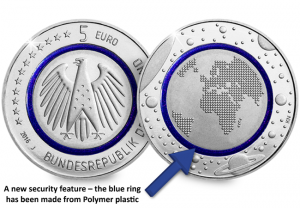
The coin features a millimetre-fine blue translucent ring made from polymer on its bi-metal surface, and this innovative technology makes it the first coin to keep up with banknotes in terms of counterfeit prevention. Remarkably the colour of the blue Polymer ring is different for each of the 5 regional mints, varying from light blue to a very dark blue. 10 years of research went in to producing this coin, and has since paved the way for a collectable series of German 5 euro coins based on the ‘climate zones of Earth’ to be issued over 5 years using the same minting techniques to produce a different coloured ring for each coin.
Error coins and rarities
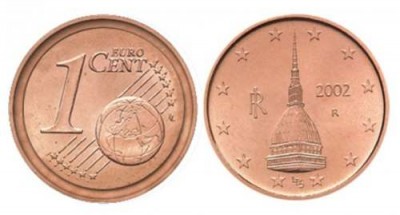
In Italy in 2002, 7,000 1-cent Mole Antonelliana error coins were struck on 2-cent blanks. These rare error coins have been known to sell for thousands of euros, with one bidding war reaching the dizzying heights of €6,600 back in 2013!
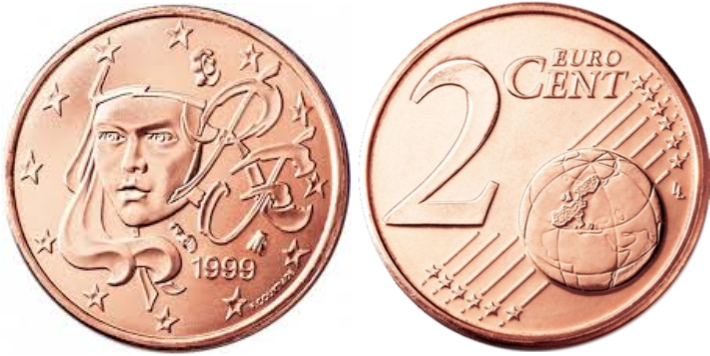
2002 was also the year that France minted just 9,000 2-cent coins featuring a young feminine Marianne, known as ‘the national emblem of France’ and a ‘personification of Liberty and Reason’. These rare coins are easily overlooked, but with so few of them in circulation they are certainly worth keeping your eyes peeled for.
Other coins with very low mintage figures include the 2011 Greek 2 euro, the 2008 German 5-cent, the 2013 Cyprus 1 euro and the 2002 Belgium 10-cent.
An interesting series of 5 euro coins to look out for comes from Germany and was created to reflect Earth’s climatic zones with the use of coloured plastic polymer rings to represent each zone. The first coin was issued in 2017 and the series will continue releasing one coin per year until 2021.
I hope you’ve enjoyed our journey through Europe and some of the fascinating finds you could discover in your change on your next trip abroad. What is the most interesting coin you’ve found in your change whilst abroad? Let us know in the comments!
Could this Bee a new error £1 coin?
2.975 million King Charles III Bee £1 coins entered circulation in August 2024. Since then, the race has been on to track down these new coins creating a buzz in the collecting world!
Many collectors have already been lucky enough to come across the Bee £1, but perhaps none so lucky as Diane Bath, who spotted a rare error on one of the coins…
The error coin causing a buzz
Diane runs The Post Office in Broughton-in-Furness, Cumbria, where she found a King Charles III Bee £1 struck in entirely one colour!
The image below shows the single metal coin, without the silver-coloured inner piece seen on standard United Kingdom £1 coins:

£1 coins are struck from a nickel-brass outer ring and an inner piece made from a nickel-plated brass alloy. It’s possible that this error coin was created due to the inner section not being punched out of the nickel-brass before the coin was struck. For confirmation of this, we’d suggest sending the error coin to The Royal Mint for verification.
Diane, a postmistress of over 20 years, told the press: “I am absolutely over the moon. Obviously we handle cash all the time and it’s the most exciting find I’ve ever had in over two decades.”
Worth a pretty penny
The coin was auctioned on 18th October by Ryedale Auctioneers, and whilst it had an estimated value of £500-£800, it actually sold for £1,250!

Image Credit: Ryedale Auctioneers
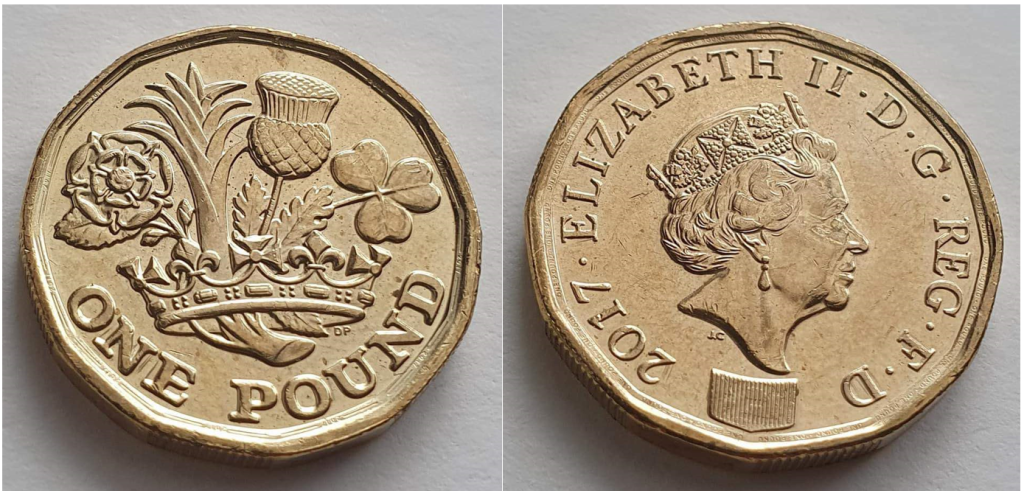
A similar error occurred when the first 12-sided £1 coins were released back in 2017, although only a small handful of these error coins were ever found. Reportedly, one such error coin sold for over £2,000 at auction!
Ultimately, the selling price of a rare error item like this at auction depends on how much a collector is willing to pay to get their hands on it. So remember, if you’re looking to secure an error coin on the secondary market, always do your research and be aware of fakes before you buy.
Have you spotted any errors on the new King Charles III coinage? Let us know in the comments below!
Secure the Complete Set of New UK Coinage!
Whilst the Bee £1 and Salmon 50p can now be found in your change, it could be years until all 8 coins can readily be found in circulation…
So don’t miss out! Own the complete set now, with each coin including a special privy mark to set them apart from the coins in your change!
Secure the complete collection for just £32.50 + (p&p) here >>

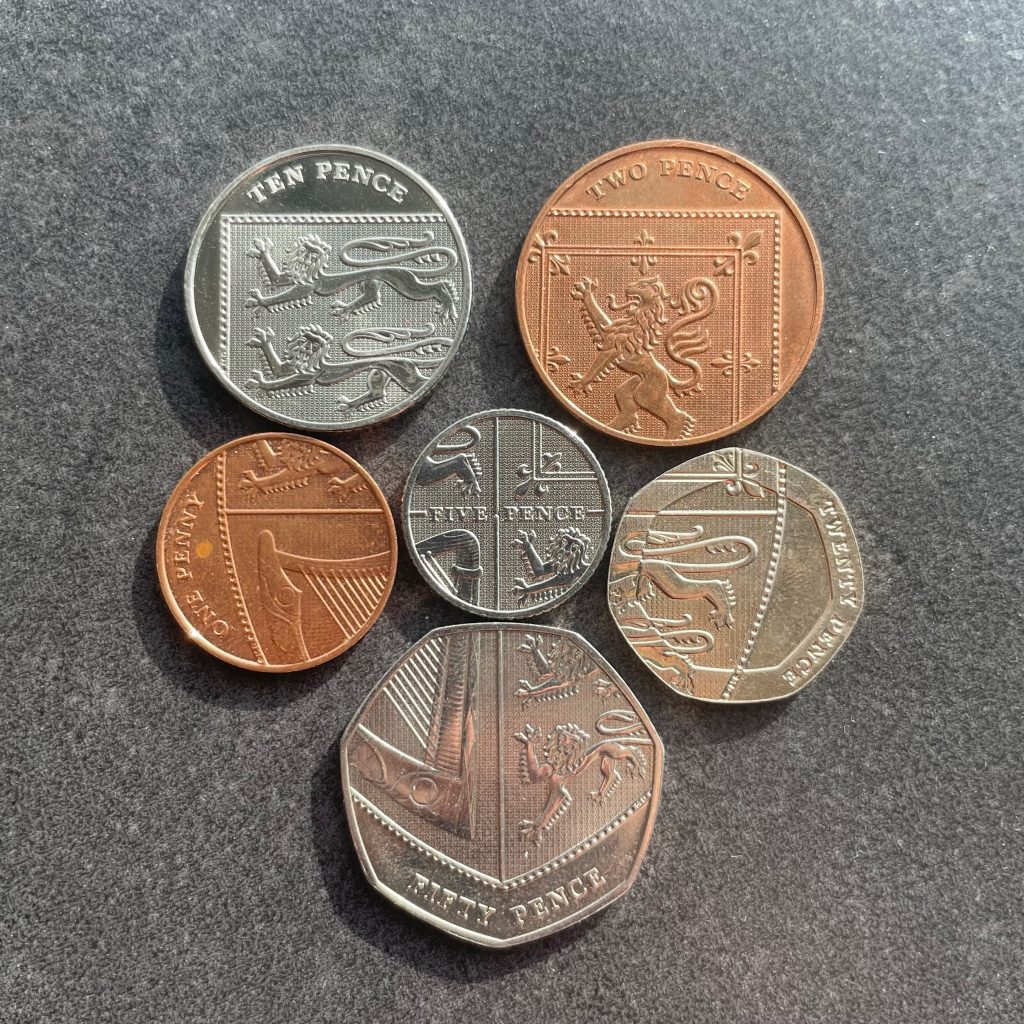
Can you complete the shield!?
It’s been 16 years since Matthew Dent redesigned the UK’s definitive coins to create the Royal Shield of Arms design, and we now have the New UK Coinage for King Charles III which will replace these designs.
So it’s hard to believe there are still some people who don’t actually realise that these coins can be pieced together to complete the shield!
Time for change
In 2005, it was decided that our definitive UK coinage was due an overhaul, and The Royal Mint ran a competition for members of the public to design the new coins. Out of 4,000 designs that were submitted, The Royal Mint Advisory Committee selected Matthew Dent’s Royal Shield designs as the winner in 2008.
Speaking about his designs, Dent said “I felt that the solution to The Royal Mint’s brief lay in a united design, united in terms of theme, execution and coverage over the surface of the coins.”
Using all the coins from the 1p to the 50p and fitting them together like a jig-saw, the complete shield is revealed – as seen on the £1 coin design issued from 2008 until 2015.

Of course, the old round pound was replaced by the 12 sided Nations of the Crown £1 in 2017 and have now been withdrawn from circulation. However, the definitive 1p, 2p, 5p, 10p, 20p and 50p shield coins can still be found in your change, meaning the Royal Shield can still be collected and completed.
In fact, I bet if you were to check the change in your pocket right now, you’d be surprised by how much of the shield you’ll already be able to piece together!
Complete the Shield
So, why not try collecting the Royal Shield coins and see if you can complete the shield? And, if you’d like to give yourself even more of a challenge, how about collecting the whole shield for each year, starting with the coins issued in 2008!
To help you on your collecting journey, you can secure your own Royal Shield Collector Pack, which includes the Royal Shield 1p, 2p, 5p, 10p and 20p – all you have to do is find the 50p in your change to complete the shield.
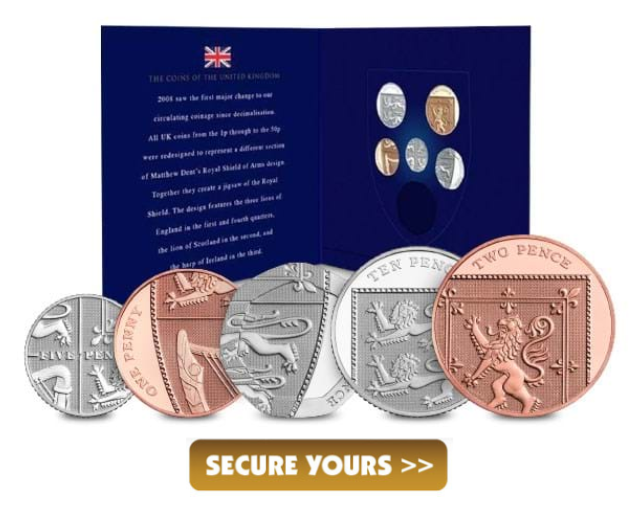
Secure your Royal Shield Collector Pack for JUST £4.99 (+p&p) >>