
Coin Grading Explained
Coin grading is all about how much wear a coin has and how many details remain. It’s the key to understanding a coin’s quality and how well it’s survived over time. Every bump, scratch, and smoothed-down detail tells a story.

The Basics
To understand coin grading, you must first understand the basics, such as the original strike type of your coin. You may have spotted coins labelled BU (Brilliant Uncirculated) or Proof, these strike types tell us how the coin was made.
- MS (Mint state or Circulation): A Mint State coin struck for general circulation.
- BU (Brilliant Uncirculated): A coin that’s never been in circulation, made using hand polished dies to give a high-quality finish.
- PF (Proof): Coins struck multiple times with highly polished dies for collectors, often boasting a mirror-like shine.
- SP (Specimen): Somewhere between a BU and a Proof. Specially made, but not quite a full Proof.
- Bullion: These coins are struck for large-scale production and are of a lower standard compared to proof and BU coins. They are primarily used for bullion investment and do not have the same level of detail or finish.
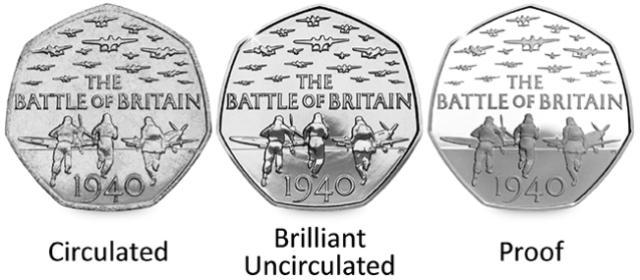
Did you know, coins intended for circulation are struck just once at a rate of up to 750 per minute, whereas Brilliant Uncirculated coins are struck twice with a greater force at a rate of up to 300 per minute, giving much more definition. Proof coins go the extra step and are struck several times at a rate of between 50 and 100 per hour.
Grading Letters and What They Mean
Grading starts from Poor (PO) and goes all the way up to Mint State 70 (MS70), meaning a perfect coin with no visible flaws – even under 5x magnification!
The basic traditional grading abbreviations can be explained as follows:
- PO – Poor: Just enough detail to identify the coin.
- FR – Fair: Some details visible.
- AG – About Good: Heavily worn, but most of the design is still visible.
- G – Good: Wear throughout, but main design elements remain.
- VG – Very Good: More detail, but still worn.
- F – Fine: Moderate wear, letters and digits still sharp.
- VF – Very Fine: Most details intact, some light wear.
- XF – Extremely Fine: Just minor wear on high points.
- AU – Almost Uncirculated: Virtually no wear, full details.
- UNC – Uncirculated: No signs of wear from circulation.
- Fleur de Coin – A coin in a mint state with an exceptional strike and no flaws. This grade is very rarely used.
If you want to get even more granular, the Numismatic Guaranty Company (NGC) uses a 70-point scale to grade their coins, here are just a few highlights from their extensive scale:
- PO1 – Poor: Just enough detail to identify the coin.
- G4–G6 – Good: Only the major design elements are still visible.
- F12–F15 – Fine: Letters sharp, details soft.
- VF20–VF35 – Very Fine: Strong detail, moderate wear.
- XF40–XF45 – Extremely Fine: Full detail with only light wear.
- AU50–AU58 – Almost Uncirculated: Nearly perfect with just a whisper of wear.
- MS60–MS70 – Mint State: No wear, straight from the mint. MS70 is the holy grail.
Look for the “+” and the “★”
Sometimes a coin just shines, literally! That’s where Plus (+) and Star (★) designations come in:
- Plus (+): Right at the top of its grade — almost good enough for the next level.
- Star (★): Exceptional eye appeal – better than others at the same grade.
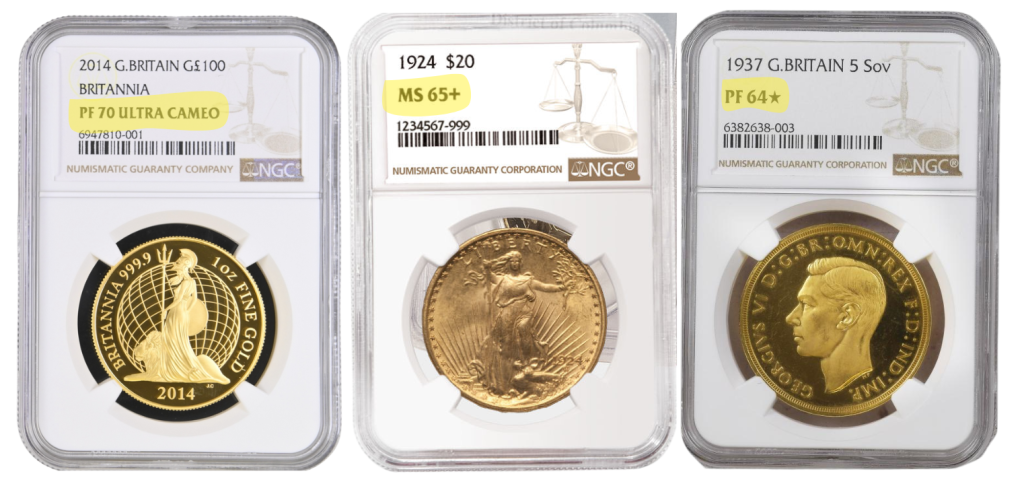
These are given automatically by NGC’s graders, so if your coin gets one, it’s extra special!
Colour, Contrast, and Character
Serious collectors love the finer details. Here are some extras you might see:
- RD / RB / BN – Tells you how much red (mint lustre) remains on a copper coin.
- Cameo / Ultra Cameo – Seen on Proof coins. Contrast between shiny fields and frosted details.
- PL / DPL – Prooflike and Deep Prooflike. These aren’t Proofs, but they’ve got that glossy, mirror finish.
What to look out for
If you’re checking your change or picking up a collector piece, here are the key things to look out for:
- Is the design still crisp?
- Can you spot any wear?
- Are there any scratches or dents?
- Has it been specially struck (Proof, BU)?
- Any bonus designations like + or ★?
The better the grade, the rarer and more desirable the coin often is!
Our Change Checker web app is completely free to use and allows users to:
– Find and identify the coins in their pocket
– Collect and track the coins they have
– Swap their spare coins with other Change Checkers

Sign up today at: www.changechecker.org/app
I found a rare1982 bronze 20p with unique mark is it worth anything