
Fifty Pound Notes Through the Ages – A History of the £50 Banknote
The £50 note has always stood out as one of the most prestigious denominations in British currency. With a history stretching back nearly 300 years, its designs not only reflect evolving security measures, but also Britain’s cultural, industrial, and scientific heritage. Let’s take a look at the fascinating story of the 50 pound note through the ages…
1725 – The First £50 Note
The very first £50 note was issued in 1725 by the Bank of England. Unlike the notes we’re familiar with today, these were part-printed and part-handwritten.
Printed features included the “promise to pay” declaration, the vignette (portrait in the top left corner), the first digit of the denomination (5), and much of the text. However, the date, issue number, cashier’s signature, and even the exact monetary value were handwritten. This meant that the note could represent sums greater or smaller than £50 if required, making it more of a money transfer tool than everyday currency.
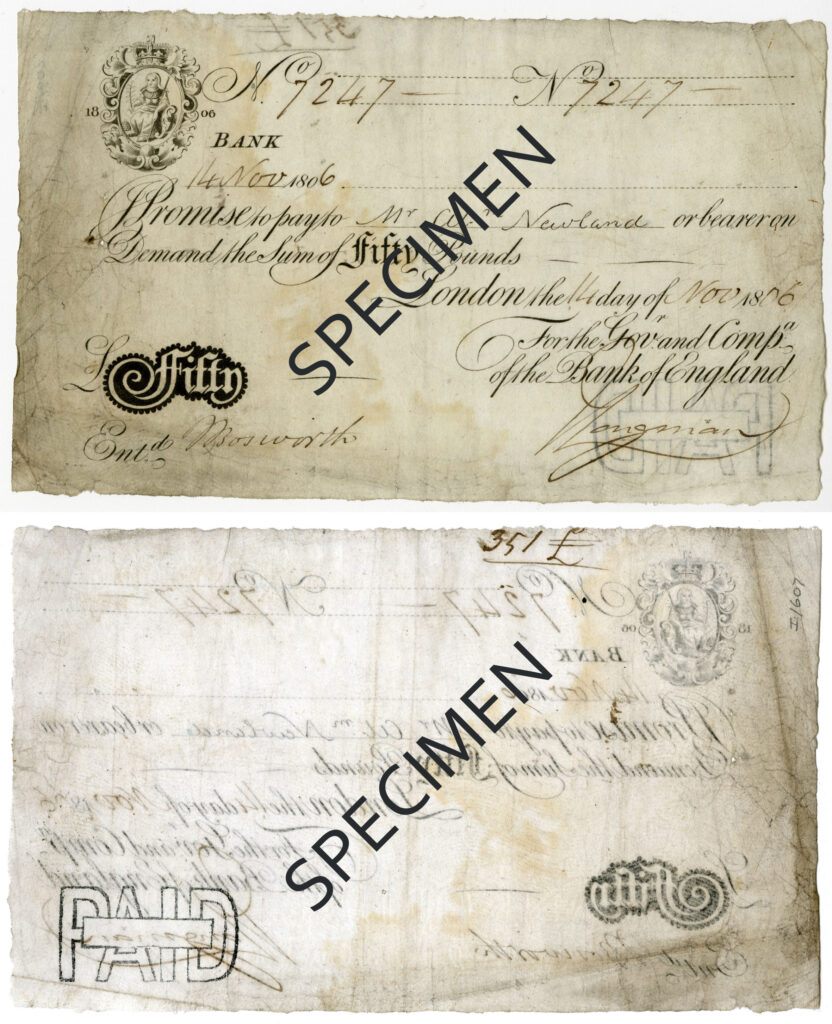
Image Credit: Bank of England
Later issues introduced printed sum blocks (the denomination in white text on a black background) to deter fraudulent alterations. A fully printed £50 banknote didn’t appear until 1855, with the note continuing in circulation until the 1940s.
1981 – The Sir Christopher Wren £50
After several decades without a £50 note, the Bank of England reintroduced the denomination in 1981 with Series D, featuring Sir Christopher Wren, the renowned architect of St Paul’s Cathedral.

Image Credit: Bank of England.
This series was notable for being the first to feature famous historical characters, designed by artist Harry Eccleston. A selection committee, including historians and senior bank officials, carefully reviewed candidates. The theme chosen was British cultural heritage, and Wren’s lasting contribution to the nation’s architectural identity made him the perfect choice.
This design firmly set the precedent for how personalities would be chosen for future banknotes – a process that continues today.
1994 – Sir John Houblon £50 and Redesign
In 1994, the £50 note was redesigned as part of Series E, featuring Sir John Houblon, the very first Governor of the Bank of England.
The release also coincided with the 300th anniversary of the Bank of England, making Houblon an especially fitting figure. The design, by Roger Withington, leaned heavily on public research – colour was identified as a crucial feature for recognition, and the traditional red-brown hues were intensified to ensure the £50 stood apart from other denominations.
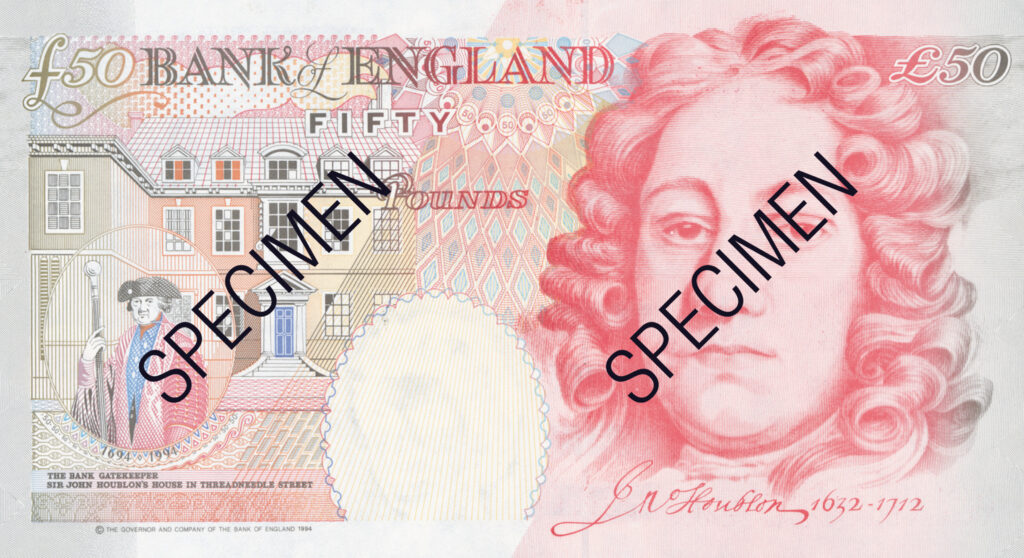
Image Credit: Bank of England
This redesign cemented red as the colour most closely associated with the £50 note, and the colour it remains today.
2011 – The Boulton & Watt £50
In 2011, a new design entered circulation featuring Matthew Boulton and James Watt, pioneers of the Industrial Revolution. Portraits of Boulton and Watt, alongside images of Soho Manufactory in Birmingham and the revolutionary steam engine featured on the reverse of the note.

Image Credit: Bank of England
Boulton was an entrepreneur, while Watt was a scientist and engineer. Together, they transformed steam engine efficiency, powering Britain’s industrial growth. Their legacy lives on not just in machinery, but also in language – the watt remains the international unit of power today.
This design reflected the spirit of invention and enterprise that defined Britain’s global role in the late 18th century.
2021 – The Alan Turing Polymer £50
On 23rd June 2021, what would have been Alan Turing’s 109th birthday, the Bank of England released its first polymer £50 note. Turing, widely recognised as the father of computer science and artificial intelligence, was chosen after a public nomination process that saw 227,299 submissions.
The note incorporates a wealth of meaningful design details, including a 1951 portrait of Turing from the National Portrait Gallery, technical drawings of the ACE Pilot Machine and the Bombe code-breaking device, ticker tape spelling Turing’s birthdate in binary and a large transparent window with a metallic microchip and clovers in tribute to Bletchley Park.

Image Credit: Bank of England
This release also sparked huge collector excitement around low serial numbers, especially AA01 notes, and key date combinations linked to Turing’s life and work.
Find out more about the serial numbers to look out for on your £50 notes >>
King Charles III and the Future of the £50 Note
In 2024, the first banknotes featuring King Charles III were issued. Importantly, the Bank of England confirmed that Alan Turing would remain on the back of the £50, and that it would feature some denomination-specific security features.

In what could be the biggest shake-up in banknote design in over 50 years, the Bank of England invited the public to help shape the future of our UK Banknotes in July 2025 – and the response was overwhelming!
Thousands of people submitted their ideas, with an incredible number coming from young people, here are just a few examples of submissions from students of the Co-Op Academy Woodlands School in Leeds.

Credit: Bank of England Facebook

Credit: Bank of England Facebook
As collectors, we know how thrilling it is when we get the chance to have our say on designs – such as the hugely popular 2011 Olympic 50ps that were designed by members of the public. With UK banknotes now getting new designs, get ready to feel that excitement all over again with the next generation of £5, £10, £20, and £50 notes! The Bank of England’s public consultation closed on 31st July 2025, and the final decision on new designs will rest with the Bank’s Governor.
A Collector’s Favourite
With its rich history, bold red design, and links to some of Britain’s greatest minds, the £50 banknote is one of the most desirable denominations for collectors. From handwritten promises to polymer notes featuring world-changing codebreakers and monarchs, the story of the £50 note is a reflection of Britain’s journey through culture, industry, science, and beyond.
Do you have an impression banknote collection? You can securely store and display them in the Change Checker Complete Polymer Banknote Collecting Pack, which includes spaces for King Charles III banknotes!
